
In October 2022, Elder Uchtdorf introduced a new edition of the For the Strength of Youth booklet in general conference.[1] From this edition onward it is subtitled “A Guide for Making Choices” and is usually referred to as “the FSY Guide” for shorthand in Church publications.[2] It’s a terrific summary of revealed principles and guidelines for moral living—both inspired and inspiring. All through my high school years, I carried a copy in my planner and a pocket version in my wallet, and even had conversations with friends about it.
The FSY Guide differs in some ways from previous editions. Both the earlier editions and the FSY Guide have included specific concrete behaviors that are recommended and discouraged, as well as the doctrinal reasons and intentions that underlie those behaviors. But the previous For the Strength of Youth pamphlets spent a larger portion of time on behaviors, while the FSY Guide definitely spends far more time on the principles behind them.
This can be quickly seen, for example, by merely comparing the tables of contents of different editions. Earlier booklets were organized by more action-oriented topics such as “Dating” or “Physical Health,” while the 2022 FSY Guide is organized by doctrinal truths such as “Your Body Is Sacred” or “Love Your Neighbor.”
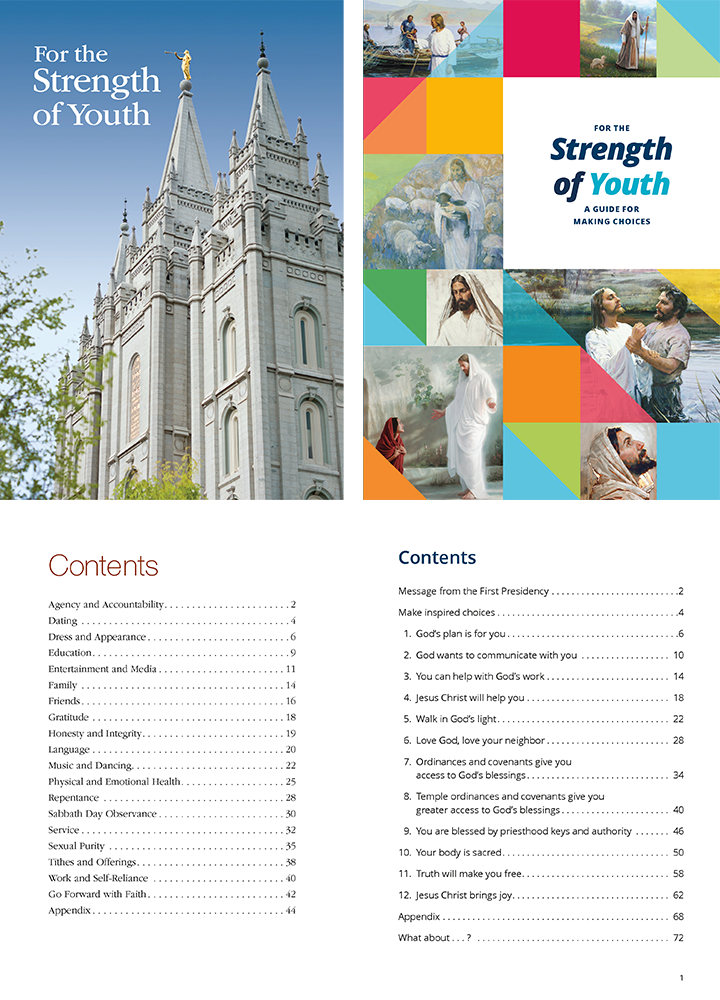
In April 2026, an updated version of the FSY Guide (11th edition) was released,[1] which doubled the number of chapters to twelve total, so youth could study one a month each year. The original chapters carried over from 2022 are substantially the same with only minor changes. Throughout this series, the term “FSY Guide” refers to either or both the 2022 and/or the 2026 editions, since most statements about one edition are true of the other. The rare times there is a relevant difference, it will be noted. A side-by-side comparison and analysis of the two FSY Guides is available at NathanRichardson.com.[2]
Misconceptions
In the nearly four years since its publication, I have repeatedly encountered misconceptions about the significance or meaning of the changes in the new FSY Guide. This has led me to feel an urgent need to write this series of articles clarifying what Church leaders are and are not saying about it.
Lest anyone suspect that I’m tilting at windmills or solving imagined problems, I’ll share a few anecdotes. They come from a variety of places around the world and not necessarily my own. In many examples like these, good people may simply not be choosing their words carefully. But the result is that many youth are absorbing the wrong understanding about Church standards.
- A young woman had a conversation at a youth activity about a year after the new guide came out. A fellow young woman told her that the FSY Guide means that all prophetic counsel given before its publication in 2022 is now obsolete and irrelevant; we needn’t refer to past counsel at all anymore.
(See what Church leaders teach about this in part 7 “Continuity.”) - Another young woman tells of how her Seminary teacher explains the new FSY Guide whenever it comes up in class: the Church has now rescinded past counsel on things like dating, or tattoos or piercings, and there are no Churchwide norms anymore on those subjects. When the young woman pointed out to her teacher that those things were taught in general conference and are still specified in, for example, the Topics and Questions section of the Gospel Library, her teacher was undeterred. “They just haven’t gotten around to removing them yet. I’m sure they’ll delete those things any day now.”
(See what Church leaders teach about this in part 7 “Continuity.”) - A stake leader conversed with a father at a youth camp, and mentioned in passing, “We don’t have standards anymore.” (See what Church leaders teach about this in part 3, the section about “Both Principles and Rules.”)
- A youth camp director was composing an email to the youth about how to prepare for camp. Among other things, she wanted to include a quote from the then-current edition of the For the Strength of Youth pamphlet about proper dress and grooming (this was shortly before the FSY Guide). Several fellow youth leaders did not want her to include it. She repeatedly clarified that she wasn’t talking about enforcement at all, and that all would be welcome no matter how they dressed; she just wanted to remind them of the Church’s guidelines. Then Elder Uchtdorf introduced the FSY Guide at general conference. At the next camp planning meeting, one of the youth leaders brought up the new FSY Guide to the camp director as further evidence that they should not mention any dress standard in youth camp communications, saying, “Things have changed in the Church since our last meeting” because the new FSY Guide had now been published. The camp director received such persistent pushback from fellow adult leaders that she gave up and refrained from quoting a Church publication about youth in her email communication about a Church-sponsored youth activity.
(See what Church leaders teach about this in the intermission “How Parents and Leaders Can Help.”) - A bishop was planning with his ward council a lesson he was going to give about the new FSY Guide. When he shared the idea, from several recent quotes from Church leaders, that there are still rules that Latter-day Saint youth should follow (see quotes in part 3), several ward council members said they felt that was against the spirit of the new FSY Guide. The bishop also explained that understanding the principle behind a particular rule means the Spirit can prompt you to apply the principle across more situations than is covered in the specific rule, resulting in a more demanding kind of discipleship, not less. Several ward council members expressed that they felt very uncomfortable with him saying that.
(See what Church leaders teach about this in part 3 “Newly-Invented Sins and Meaningful Obedience.”) - One friend told another that “the new FSY Guide doesn’t use the word standards” In fact, the word appears five times in the October 2022 FSY Guide, and eight times in the 2026 version.
(See what Church leaders teach about this in part 3 “__.”)
Again, we’re all busy (especially our local leaders who serve so selflessly) and can’t be experts on every new Church publication or development. But I beleve this very small sampling of incidences, from just my own limited degrees of separation from the sources, illustrate that this is a prevalent, if not ubiquitous, line of thought entrenching itself among members of the Church, among both youth and adults.
And this is only what I’ve encountered for myself in my own direct conversations. If you want to see more, join any Latter-day Saint social media group or thread about parenting or youth activities, and watch what happens any time someone expresses concern about a relaxing of standards since the new FSY Guide came out. Many, if not most, of the responses will assert that that is precisely the intended result of the changes, and that the OP is kind of off-base for even wishing for clear shared standards anymore. You may also notice that these mistaken views about the FSY Guice are expressed in the absence of any supporting statements from general authorities or general officers.
I even took the step of administering an objective qualitative measurement to a group of youth, to quantify how well they understand what the FSY Guide says about standards. You can read how I assessed that and what the results were in part 4: “The Revelation Pattern.”
Here is a list of prevalent misconceptions, boiled down to their simplest forms. They’re not always put so succinctly in these terms, but they often lie at the heart of the assumptions being made in conversations about the FSY Guide.
- “Loosening”
- “We don’t have standards anymore.”
- “The rules have been relaxed; the bar has been lowered.”
- “People were trying too hard to be good. That’s Pharisaical.”
- “Principles are less demanding than rules, and less likely to offend others.”
- “Just Feel and Act”
- “The only standard now is ‘Just do what seems right and feels good to you.’”
- “OK, the standard now is ‘Just pray and then do what feels good to you.”
- “OK, the standard is ‘Just read the FSY Guide, then pray and do what seems good.”
- “Obsolescence”
- “All prophetic counsel from before October 2022 (when the FSY Guide was first published) is now invalid and can be ignored. In fact, it’s even kind of dubious or improper to refer to such previous counsel.”
- “It’s now OK to ____ [fill in the blank with any preferred behavior].”
- “No Shared Norms”
- “There are (or should be) no institutional rules now, only individual ones.”
- “Parents and Church leaders shouldn’t set rules anymore, like dress standards for Church activities or dances.”
- “Rules are unnecessary and even spiritually inferior. It’s wrong to want shared norms.”
- “Parents’ role is merely to affirm their child’s choices.”
All of these wrong ideas have been addressed and countered by Church leaders, including within the last fouryears, in public addresses, interviews, and trainings published by the Church specifically about the new FSY Guide.
Teachings of Church Leaders
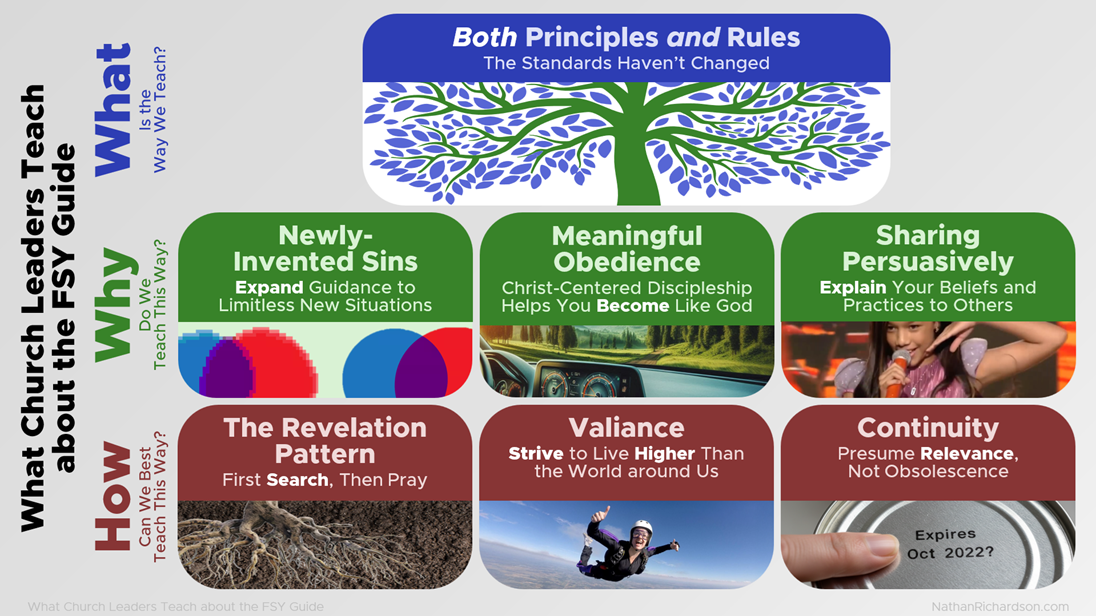
In contrast to these myths at the popular level, Church leaders have publicly taught very different things about their purposes in shifting the approach in the FSY Guide. This is how I would summarize their main ideas, in the order I address them:
- Both Principles and Rules. We still have standards and rules, and they haven’t changed. We’re simply renewing our emphasis on also teaching the principles and reasons behind them.
- Newly-Invented Sins. Principles help you expand guidance to endless new situations.
- Meaningful Obedience. Christ-centered discipleship helps you become like God and act out of love for him.
- The Revelation Pattern. You are responsible to first search, then pray.
- Sharing Persuasively. Principles help you explain your beliefs and practices to others in a compelling way.
- Valiance. We should strive to live higher than the world around us.
- Continuity. Presume relevance, not obsolescence, when studying prophets’ teachings.
It’s even more helpful to think of these key ideas in the categories of what we teach, why we teach it, and how we teach it. After this introductory overview of this series, I will devote an article to each of these main ideas (part 3 combines main ideas 1, 2, and 3 into one article). For each, I have included at least one major metaphor or story that encapsulates the main idea in a memorable mnemonic, as can be seen with the images that accompany each main idea.
I am writing this series of articles to expand on these main ideas, showing how they are repeatedly taught by Church leaders, especially recently by the same people who revised the FSY Guide.
Key Sources: Authoritative and Reliable
By this point at least some readers might be wondering, “But Nathan, how can you be so sure this is how Church leaders want us to interpret the FSY Guide? Because what you’re claiming is very different from many things I’m hearing among members of the Church.”
I too found the FSY Guide a little disorienting at first. I was immediately willing to make whatever changes Church leaders were asking of us, in what and how we taught. But some of the things I was hearing people claim left me skeptical as to how well the popular understandings were reflecting Church leaders’ intentions. Indeed, Steven J. Lund, the president of the Young Men General Presidency who oversaw the revision of the guide, has lamented, “More young people have read about [it] on social media than have read … the FSY guide [itself].”[1]
I finally decided to do a deep dive and read everything I could find from Church leaders about the hows and whys of the new FSY Guide. I knew that was the surest way to understand their intentions. Beginning in June 2024, I consumed everything I could find on the subject—every article, interview, and training I could find in Church publications and official media outlets. I also started reading the Church’s youth magazine more regularly and carefully. In part 2 of this series, I reproduce my current list of reliable sources that I’ve used, in order of publication.
I will tend to set statements as blockquotes even when they’re fairly short, so that it makes it easier for readers to skim these articles to locate authoritative quotes. For some of the more important quotes, I will also provide video segments, which can be especially effective for sharing these teachings in classes or trainings. For ease of reference, I will list here the General Officers who administered the revision of the FSY Guide in 2022, because they are frequently the speakers and authors being quoted in these authoritative sources:

Young Women general presidency (Apr. 2018–Aug. 2023)
President: Bonnie H. Cordon
1st Counselor: Michelle D. Craig
2nd Counselor: Rebecca L. Craven
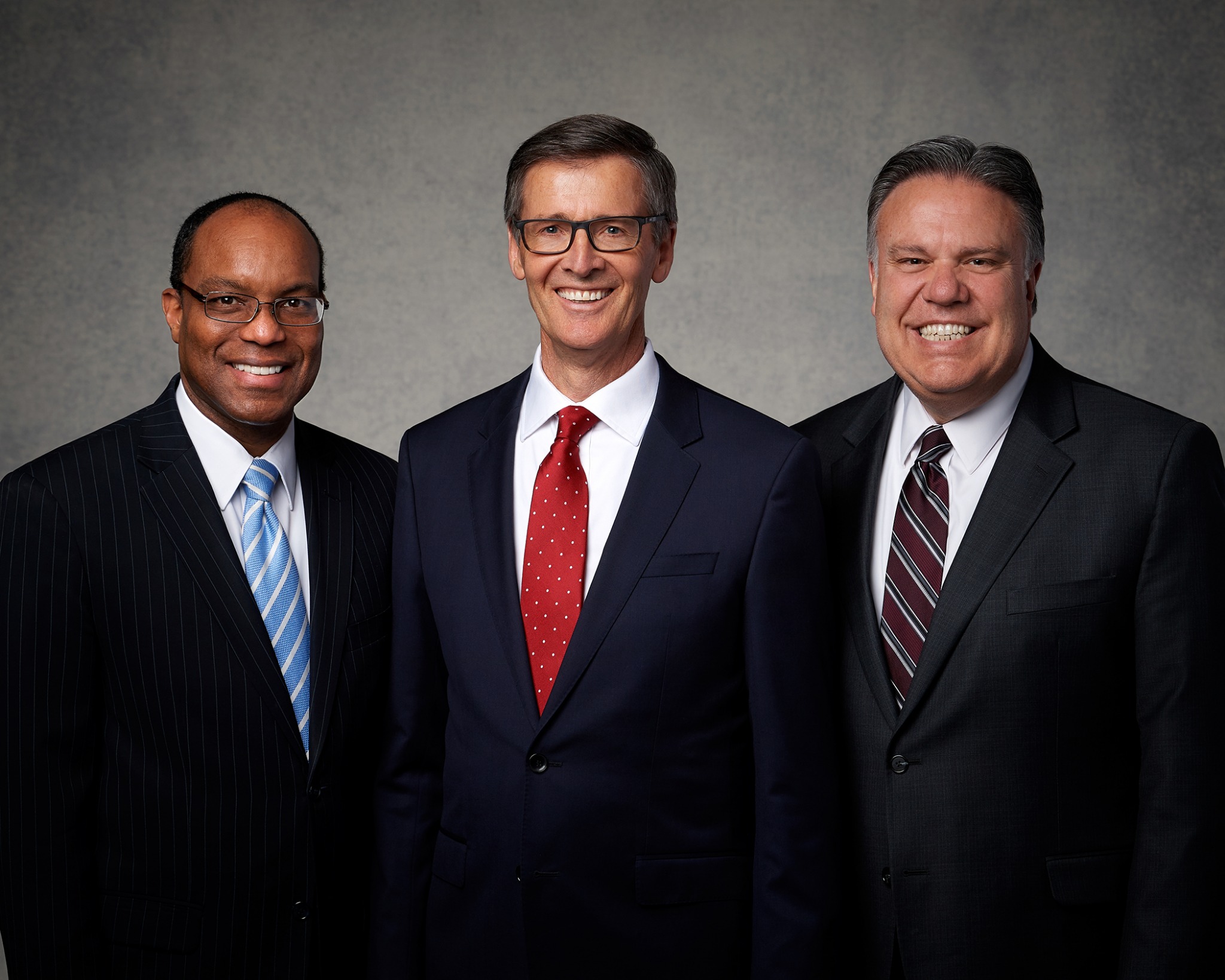
Young Men (Apr. 2020–Present)
President: Steven J. Lund
1st Counselor: Ahmad S. Corbitt
2nd Counselor: Bradley R. Wilcox
(Note: In April 2023, Ahmad Corbitt became a Seventy and left the Young Men General Presidency, Brother Wilcox became the First Counselor, and Michael T. Nelson became the Second Counselor.)
I have read or watched all of these sources, and most of them multiple times. It doesn’t take long to clearly see and absorb the leaders’ intended goals and purposes. And they are nothing like the misconceptions I’ve listed above. In many cases they are the exact opposite.
Suggestion for Improving the Gospel Library
I also learned, though, that many of these sources are tucked away in relatively obscure places. If you go to the Gospel Library app or website and click on Youth, you will find the For the Strength of Youth Guide itself, but you will find exactly none of these sources. By far the most helpful and important pieces are (1) a few “parent training” classes taught by the Young Men and Young Women General Presidencies who rewrote the guide, and (2) a few interviews with these same presidencies on the Church News podcast.
But the parent training classes are buried in the the Gospel Library under Adults Women BYU Women’s Conference. Who on earth would know to look there for material clarifying the new FSY Guide? Not a youth, that’s for sure, and probably not many fathers. And not a Deacons Quorum advisor, or Youth Sunday School teacher, or Seminary teacher who want to know how to best teach the new FSY Guide. I only found them because I happened to hear a chance comment in an unrelated conversation; I don’t think I ever would have found them otherwise.
Likewise, the Church News podcast is not exactly obscure, but it’s not on most members’ radar, and it’s not accessible via the Gospel Library app or Church website; you won’t know it exists if that app/site is your base of study. It’s also not translated into multiple languages for general consumption around the worldwide church.
For a change as important as this new FSY Guide, basic explanatory materials need to be placed front and center in a prominent place in the Gospel Library. If it ain’t there, people ain’t finding it. So not to be critical, but I do have this specific recommendation: you guys at the Church offices in charge of the Gospel Library app and website—create icons and links to these materials right there in the Youth section of the app and website, please!
Why Should I Care, If I’m Not a Youth?
Some readers may think, “I’m not a youth anymore, so why should I be interested in anything about the new For the Strength of Youth Guide?” Others might add, “I don’t even have kids at all, much less any teenagers.” Elder Uchtdorf answered that question when he introduced the booklet in general conference:
I am also speaking to those who used to be young, even to those who can’t really remember it anymore.
And I speak to all who love our young people and want them to succeed in life.[1]
So even if you aren’t a youth, you may meet one some day (I hear they’re pretty thick on the ground). And as a disciple of Jesus Christ, you will naturally want to play any part you can in helping them to understand the prophets’ counsel on these many everyday choices, and to gain a conviction of the importance of following it.
There’s another reason this topic should interest anyone reading. Sister Becky Craven said in general conference:
The For the Strength of Youth pamphlet contains standards that, when followed carefully, will bring rich blessings and help us stay on the covenant path. Although it was written for the benefit of the youth, its standards do not expire when we leave the Young Men and Young Women programs. They apply to each of us all the time.[2]
When we really understand how inspired moral standards bless our lives, we’re eager to find out (and share) any counsel the prophets have given. This is why the apostles frequently use this booklet as their primary way of introducing who Latter-day Saints are as a people.
This is … the booklet that, interestingly, Elder Uchtdorf carries in his shirt pocket and has for decades, and pulls that out when he’s meeting with heads of state or dignitaries. This is his first go-to to explain what the Church is about: “Well, let us talk to you about the values that we instill in our youth.” So that will be a good asset for all of us.[3]
Organization of This Series (What to Read First)
All of the key primary sources I use in this series are (1) published by the Church, (2) about the new FSY Guide, (3) after the new guide was published in October 2022, and (4) essentially from the very leaders who revised the guide. I have read or watched all of them, and most of them more than once.
From these sources I’ve collected key quotes that best explain the purpose and intent behind the revision of the guide, and best address the common misconceptions I’ve identified in part 1. There are over forty of these key quotes. I have organized them into seven main ideas that leaders consistently repeat and emphasize.
I wish this series could be briefer and punchier than it is. If I had any authority myself, I would simply explain the ideas. But I need to prove my claim that I’m accurately reflecting the intentions of Church leaders, handle potential objections, and generally cover my bases, which requires using multiple authoritative sources like I have. It also takes time to string the quotes together and explain how they teach the seven main ideas. So while I’ve tried to be concise, I have to be thorough first.
Once this series is up and available, perhaps then the next step can begin of condensing, popularizing, and sharing these ideas more widely, because influencers and content creators will be more confident that they are disseminating the expressed intentions of Church leaders.
1. Video Playlist of Key Quotes
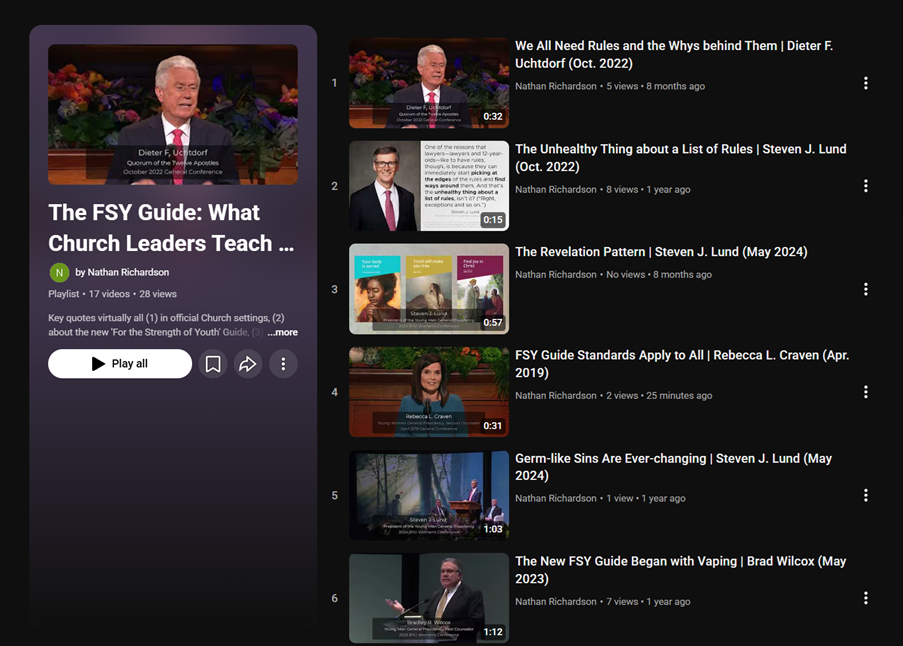
If you don’t have the time to read through these sources or even this article series, I have created a YouTube playlist of all the key quotes, excerpted from the recordings of the Church leaders they come from. I highly recommend simply listening to those key quotes to get the main ideas from Church leaders. They are brief and to the point, and total less than an hour to listen to.
If you go no further in this series—if you stop reading now and never return to finish these articles—please go listen to this playlist and share it. It has the greatest impact, simply seeing and hearing what Church leaders themselves are actually saying about the FSY Guide.
2. Printable Collection of Key Quotes
I have also collected these quotes as text in a PDF that can be printed as handouts, perhaps as part of a Standards Night or classroom setting. The quotes are organized into the seven main ideas, with graphics and diagrams to help make them more memorable (and because no one wants to just read a solid wall of unbroken text; magazine layout is more digestible).
Again, if you read no further in this series—if you close this window and never return—the best use of your limited time would be to simply read these twenty pages of quotes. Once you’ve listened to Church leaders themselves explain their intentions, it will clear up 99% of the misconceptions you’re hearing.
[Printable Collection PDF]
What Church Leaders Teach about the FSY Guide: Key Quotes

I honestly feel that no discussion of the FSY Guide can or should proceed until the people involved have familiarized themselves with these teachings from Church leaders. If someone has drawn different conclusions about Church leaders’ intent in revising the FSY Guide, the burden of evidence is on them to produce authoritative statements that support their conclusions, as well as explain away this collection here.
3. List of Original Sources
Here is a link to the full list of sources I’ve studied so that I can honestly say I’ve tried to include all relevant instructions from Church leaders. If I’ve missed anything, please tell me. The most helpful sources are marked as Key sources.
[List of sources is forthcoming]
Closing
I hope this introduction has persuaded you that there exists a problem to be solved. I hope that the rest of this series succeeds in solving it.
Misunderstanding the reasons for the change of approach in the FSY Guide can lead to spiritually detrimental drifting. But understanding and embracing the true reasons has the potential to convert your, your children’s, and your loved ones’ discipleship in amazing ways.
In the next article, I will explain what the main approach is that leaders want us to use, and one reason why it’s such a good way to teach youth. I’ll also tell you about an apostle who asked a bartender for a drink, and then admitted it in general conference.
Notes
[1] The 10th edition since its debut in 1965, according to Wikipedia.
[2] At basically the same time, they also announced youth conferences called “For the Strength of Youth” and the renaming of the youth magazine The New Era to For the Strength of Youth. For clarity, they can be referred to as the FSY Guide, FSY conferences, and FSY magazine.
[1] “Youth Around the World Invited to Prepare for New Curriculum,” Newsroom.ChurchOfJesusChrist.org, 17 Apr 2026 (link).
[2] Nathan Richardson, “FSY Guide Comparison: 2026 vs. 2022,” _Jun 2026, NathanRichardson.com (link).
[1] Steven J. Lund, “The New For the Strength of Youth Guide,” 2023 BYU Women’s Conference, 5 May 2023, Gospel Library (link).
[1] Dieter F. Uchtdorf, “Jesus Christ Is the Strength of Youth,” gen conf, Oct 2022 (link).
[2] Becky Craven, “Careful versus Casual,” gen conf, Apr 2019 (link). Note that at the time she said this, she and the rest of the youth General Presidencies were already working on revising the booklet. President Cordon and President Lund have both made comments to the effect that counsel about the previous booklets can also be applied to the new FSY Guide. President Cordon’s comment is in the video above of Sister Craven’s quote. President Lund’s comment is quoted, and in a video, in part __ of this article.
[3] Steven J. Lund, “The New For the Strength of Youth Guide,” 2023 BYU Women’s Conference, 5 May 2023, Gospel Library (link).

0 Comments